Give or treat yourself to a subscription to Boats in Motion print + digital and for only 39 euros a year you get the magazine at home plus read it on your PC, smartphone and tablet. With a sea of advantages.
Schools of tuna approach the coast around May and remain there until late fall.
Fishing from the boat for tuna, understood as sport fishing, is one of the most popular activities among fishing enthusiasts in our country. It can be caught by drifiting (catching it in the current from stationary with sardine touches), or by spinning on the eats (fishing it with artificial lures dedicated to this technique), or trolling.
When we talk about tuna, we are referring to the large family of tunnids, i.e., albacore, tuna mackerel and, of course, also the king of the sea, the great Bluefin Tuna, a species the latter of which has been declared endangered and is therefore regulated at the European level with rules aimed at its conservation. Sport fishing for bluefin tuna can be practiced, but with specific regulations and at a specific time of the year: from June 16 to October 14. Let’s go and see how it works.
Bluefin tuna fishing: who governs it
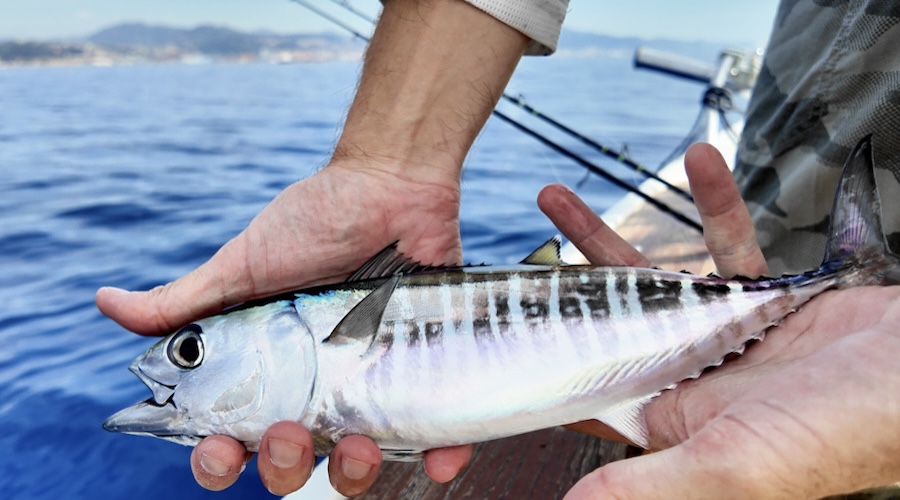
Bluefin tuna especially when juvenile, but also when adult, live can be distinguished by these distinctive lighter vertical thin lines along the flanks. Not to be confused with skipjack and skipjack tuna, which do not possess these streaks on their sides.
Tuna management is not a purely Italian matter. The “direction” belongs toICCAT (International Commission for the Conservation of Atlantic Tunas), an intergovernmental organization that sets global fishing quotas.
The European Union transposes these directives and distributes them among member states. In Italy, it is the Ministry of Agriculture, Food Sovereignty and Forestry (MASAF) that administers the annual decrees that set the dates, limits and methods of harvesting.
The mainstay of regulation is the TAC (Total Allowable Catch), better known as the quota system. Each year a maximum amount of tuna that can be caught throughout the Mediterranean and Atlantic is set. This quota is divided into “individual quotas” allocated to different fishing categories (purse seine, longline, set tuna, sport fishing). If a category’s allocated quota is reached before the end of the season, the Ministry orders immediate cessation of activities.
Every legally caught bluefin tuna must be accompanied by the Bluefin Catch Document (BCD). It is a kind of electronic “passport” that follows the fish from the boat to the fishmonger’s counter or restaurant.
Without this document, tuna is considered illegal (poaching). The penalties for violating these regulations are very heavy: you risk fines of thousands of euros, seizure of equipment and even criminal charges.
Sport fishing for bluefin tuna, what rules?
Sport fishing for bluefin tuna is regulated extremely strictly to prevent recreational activity from jeopardizing the recovery of the species. For 2026, the rules confirm a system based on prior authorization, catch limits and precise time windows.
It is not enough to have fishing gear and a boat; two basic documents are needed. The first is the Sport Fishing Census (MASAF): the free communication to be made on the Ministry’s website (SIAN). From 2025/2026, this document must be compulsorily attached to the application for tuna.
The second document is the Nulla Osta from the Coast Guard: it is necessary to apply for a specific permit for the boat that will be sport fishing for tuna at the relevant Coast Guard. The permit is tied to the boat (not the person) and is usually for three years.
The “harvested” sport fishing period is generally set from June 16 to October 14. However, there is a pitfall: the national quota. If all Italian sport fishermen reach the limit of tons allocated by the Ministry before October 14, the fishery is closed by emergency decree. Once the quota is closed, only Catch & Release (catch and immediate release without harming the animal) can be practiced.
Minimum size allowed
If you are in the opening period and the quota is not exhausted, you can retain fish only if you meet certain parameters. Quantity: maximum 1 fish per day per boat (regardless of the number of fishermen on board). Minimum Size: tuna must weigh at least 30 kg or have a length (measured from the tip of the snout to the fork of the tail) of at least 115 cm.Prohibition of Trade: It is absolutely forbidden to sell sport caught tuna. The penalty is a hefty fine and seizure of the catch.
The post-billing procedure is the part where most mistakes are made.Before returning to port, you must notify the Harbor Master’s Office by radio (VHF) or telephone. Within 24 hours of landing, you must deliver or forward the catch declaration form to the Maritime Authority that we have previously obtained by requesting it from the Port Authority. Integrity of fish: Tuna must be landed whole. It is forbidden to clean it, cut it into slices or deprive it of its head before inspection or control in port.
Powerboats, its stories, from small open to motoryachts. Sign up now for our free newsletter and receive the best news selected by the editorial staff each week. Enter your email below, agree to the Privacy Policy and click the “sign me up” button.
The sport and recreational fishing, recreational boating, and outdoor communities are getting ready to set course for Rimini. From February 12 to 14, 2027, the exhibition center in this city in Romagna will host the latest edition of Pescare Show, the trade show organized by Italian Exhibition Group (IEG) that serves as a key event
Fall has officially begun, and for sport fishing enthusiasts, it’s the most exciting time of the year. After the summer heat and record-high water temperatures, the first fall storms cool and reoxygenate the sea, reawakening the entire food chain. In the new video posted on the Barche a Motore YouTube channel, we head along the
We attended the final of the Suzuki Fishing Cup, the exciting fishing tournament organized by Suzuki and held over four stages from May to September, to see up close how a competition dedicated to drifting unfolds and to discover what features a boat needs to best handle this technique. The perfect boat for drifting Drifting
Boat fishing enthusiasts, here we go! That season—fall—has finally arrived, and it’s the ultimate expression of our passion. In fact, with the end of summer and the arrival of the first rains and the very first storms, the sea comes alive again, and boat fishing thrives for at least two months—until late November—when the coastal
Gestisci Consenso Cookie
Per fornire le migliori esperienze, utilizziamo tecnologie come i cookie per memorizzare e/o accedere alle informazioni del dispositivo. Il consenso a queste tecnologie ci permetterà di elaborare dati come il comportamento di navigazione o ID unici su questo sito. Non acconsentire o ritirare il consenso può influire negativamente su alcune caratteristiche e funzioni.
Funzionale
Always active
L'archiviazione tecnica o l'accesso sono strettamente necessari al fine legittimo di consentire l'uso di un servizio specifico esplicitamente richiesto dall'abbonato o dall'utente, o al solo scopo di effettuare la trasmissione di una comunicazione su una rete di comunicazione elettronica.
Preferenze
L'archiviazione tecnica o l'accesso sono necessari per lo scopo legittimo di memorizzare le preferenze che non sono richieste dall'abbonato o dall'utente.
Statistiche
L'archiviazione tecnica o l'accesso che viene utilizzato esclusivamente per scopi statistici.L'archiviazione tecnica o l'accesso che viene utilizzato esclusivamente per scopi statistici anonimi. Senza un mandato di comparizione, una conformità volontaria da parte del vostro Fornitore di Servizi Internet, o ulteriori registrazioni da parte di terzi, le informazioni memorizzate o recuperate per questo scopo da sole non possono di solito essere utilizzate per l'identificazione.
Marketing
L'archiviazione tecnica o l'accesso sono necessari per creare profili di utenti per inviare pubblicità, o per tracciare l'utente su un sito web o su diversi siti web per scopi di marketing simili.