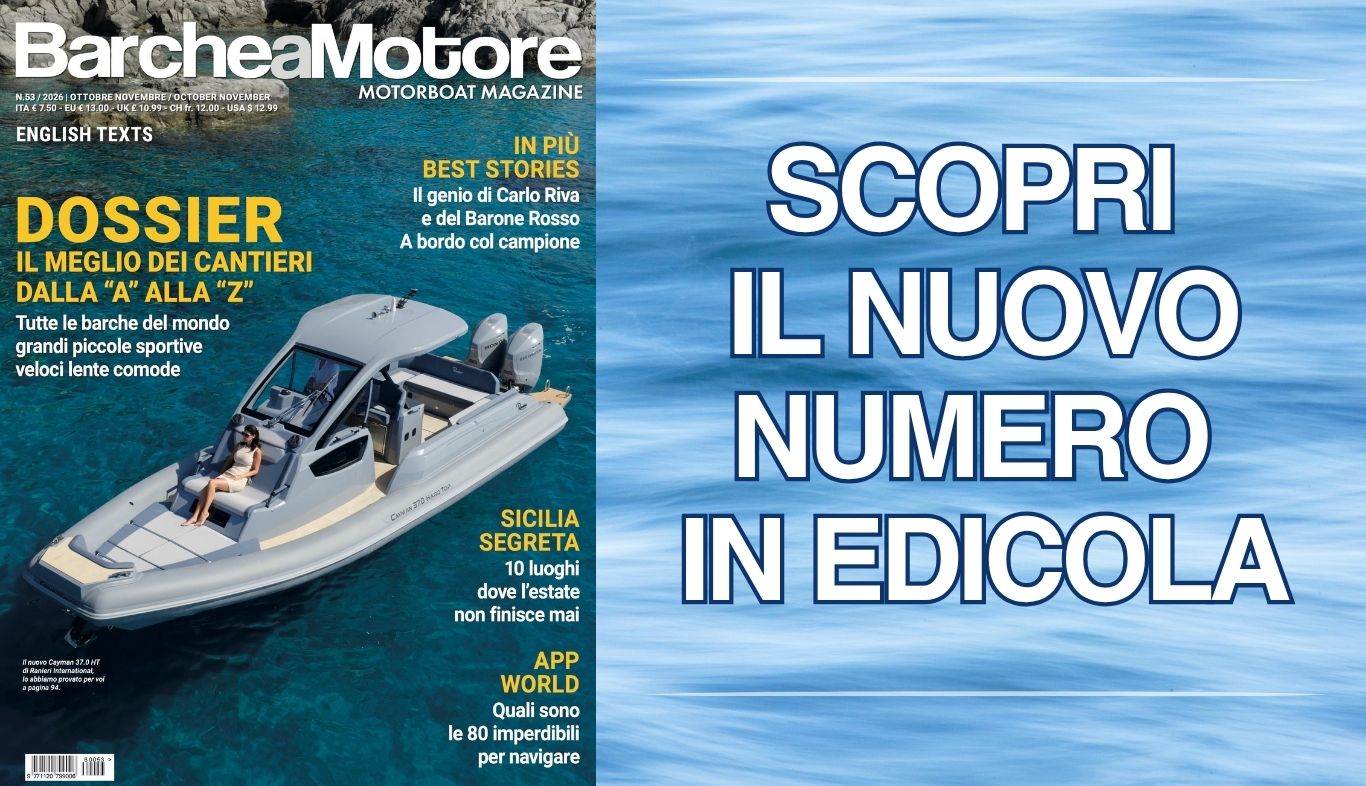
Give or treat yourself to a subscription to Boats in Motion print + digital and for only 39 euros a year you get the magazine at home plus read it on your PC, smartphone and tablet. With a sea of advantages.
Welcome to the special Classic Boat Archive section, where Boats by Motor opens for you its paper archive where hundreds and hundreds of boats we have tested, presented and reviewed in the magazine’s more than 35-year history are kept. Technical data, original boat data sheets, including engines and performance. In short, a database (constantly being updated) that contains everything you need to know about Classic Boats.
CNT Cayman 38 WA
In 1997, Cantieri Navali del Tirreno introduced the Cayman 38 WA, an impressive fisherman with plenty of free deck space, featuring two cabins and a well-equipped living area to ensure comfortable cruising.
Taken from Motor Boats 1997, no. 1, February, pp. 75-78.
Oversized shipboard steels and well-placed discharge scuppers
DEFECTS:
The guest cabin could be wider
Finishes of cabinets can be improved (protruding screws)
Toilets fixed a little too high in the guest toilet and the owner’s toilet
Presented at the last Genoa Boat Show, the new Cayman 38 WA was designed and fine-tuned by Cantieri Navali del Tirreno to satisfy a particular “market niche”: medium/large boats for sport and semi-professional users. Putting all their experience to good use, the staff of Cantieri Nav ali del Tirreno has been able to “invent” a boat that is as good for deep-sea fishing as it is for medium- and long-range cruising.
Project:◊◊◊◊
Currently, the shipyard envisions for the Cayman 38 WA only cockpit steering, but a new version with a flying bridge is being studied and will be presented to the market shortly. The hull, which will remain unchanged, features an 18° deep V, with two longitudinal runners interrupted mid-hull. To ensure good trim and correct inclination of the propeller shafts, the engines have been placed in the middle of the hull, with the tanks lateral to the engines themselves. The boat has a generous beam width for better lateral stability and for more available space on deck and internally. Despite the wide side decks (28.5 cm), which allow the bow to be reached safely, the interior is very habitable, and it was possible to create as many as two separate cabins, with as many double bathrooms, and a cozy but complete saloon.
The hull and deck are made of fiberglass, with balsa and fiberglass sandwiches and reinforcements at points most subject to stress. The bathrooms are counter-molded, thus ensuring greater cleanliness. There are no buoyancy reserves on board, but three watertight compartments divide the hull into bow, center and stern sections. The anchorage of the bulkheads to the hull is resined.
To the left is the passenger sofa, which can be supplemented with a hideaway table. To the right is the wheelhouse, located to starboard, equipped with an ergonomic steering wheel and instrumentation.
Cayman 38 WA Deck :◊◊◊◊◊
The Cayman 38 WA is equipped with an anchor nose and 1200 W electric windlass, with a chain cockpit, with extreme forward seating of the sunbathing area that occupies the entire forward pontoon and is 2.01 x 1.72 m in size. Side walkways lead into the cockpit. The aft area is left mostly unobstructed, with lockers and fish tanks on the floor, except for a settee inserted in the inner part of the transom. The gunwales contain two compartments for mooring lines and recessed rod holders. The area carved out above the engine compartment, which has a slightly higher elevation than the other part of the cockpit, is furnished to port with an L-shaped settee that can be used as a dinette, and to starboard with the swivel and adjustable pilot’s chair. The helm station is quite extensive, complete with electric tachometer, hour meter, water and fuel gauges, oil pressure gauges, water temperature thermometers, horns for engine malfunctions, and digital echosounder. The aft swim platform houses the swim ladder that disappears into the deck and is served by a well-placed stainless steel handrail.
At left, the practical galley of the Cayman 38 WA. At right, the master stateroom, equipped with a dedicated toilet, with ample storage space and good interior height.
Interior: ◊◊◊
Expanded already in the versions following the one tested, the interior includes a kitchenette with sink, refrigerator and 4-burner stove in the saloon and a small dinette to starboard. To port, on the other hand, is the guest cabin with two single beds side by side, closet and bedside table, with direct access to the toilet, twin to the owner’s, equipped with toilet (from the seat set a bit too high), recessed sink, various lockers and shower. The forward cabin features a double bed, closets and drawers.
Boat data.
Cayman 38 WA Plant engineering:◊◊◊◊
Definitely complete all the plant engineering, with special care taken in the implementation of the electrical system, which has cables larger than the standards dictated by the RINa.
DMV: ◊ ◊◊◊
The Iveco Aifo 836 SRM40 – 400 hp is the ideal engine for application on fast pleasure hulls. The two engines under the dinette/driver’s seat area floor in the cockpit can be easily reached for maintenance or inspection by electrically raising (system supplied optional) the floor itself, with all furnishings above.
The performance measured by our test and the dinette.
Performance: ◊ ◊◊◊◊
When sailing, the Cayman 38 WA seems to run on rails, so stable and directional is it. It forgives any mistakes and is easy to steer even for the inexperienced. In maneuvering, it is equally docile and allows precise dockside approaches.
by Roberta Limardo
Are you a Classic Boat enthusiast or simply curious about the excellence of the past? Then the Classic Boat Archive is the place for you: the only column where the entire history of powerboating is made accessible to the public, boat by boat, article by article. Find out what’s already online and keep monitoring the archive-it’s updated four times a week! For your convenience, you can check it out by clicking HERE!
Powerboats, its stories, from small open to motoryachts. Sign up now for our free newsletter and receive the best news selected by the editorial staff each week. Enter your email below, agree to the Privacy Policy and click the “sign me up” button.
The second edition of Seaquip, the leading B2B event dedicated to marine accessories, technologies, and components—scheduled for March 2–4, 2027, at the Fiera Milano Rho exhibition center—continues to attract a lineup of top-tier participants. New confirmations of participation from leading players in the maritime industry further reinforce the event’s international scope, highlighting Milan’s logistical and
Welcome to the Classic Boat column, the magazine’s historical and cultural “guardian”—a space dedicated to exploring the figures, boats, and design developments that have shaped the evolution of motorboating. In this article, we’ll retrace our steps to look back at three pivotal moments— three beginnings destined to become the starting point of a broader adventure:
Portofino 10 Fly The Portofino 10 Fly, featured in the May 1994 issue, is the result of a winning combination of modern construction technologies and the tradition of Ligurian shipbuilding. The result is a hull perfectly suited for long-range cruising, capable of handling challenging sea conditions. It was designed by Angelo Zagano. Excerpted from *Barche
All it takes is a warmer or colder day, and the inflatable boat changes shape. These aren’t leaks, of course, but rather the tubes, which have varying internal pressure depending on the temperature. The lower the temperature, the lower the pressure. If we leave the inflatable boat in the sun all day, however, the air
Gestisci Consenso Cookie
Per fornire le migliori esperienze, utilizziamo tecnologie come i cookie per memorizzare e/o accedere alle informazioni del dispositivo. Il consenso a queste tecnologie ci permetterà di elaborare dati come il comportamento di navigazione o ID unici su questo sito. Non acconsentire o ritirare il consenso può influire negativamente su alcune caratteristiche e funzioni.
Funzionale
Always active
L'archiviazione tecnica o l'accesso sono strettamente necessari al fine legittimo di consentire l'uso di un servizio specifico esplicitamente richiesto dall'abbonato o dall'utente, o al solo scopo di effettuare la trasmissione di una comunicazione su una rete di comunicazione elettronica.
Preferenze
L'archiviazione tecnica o l'accesso sono necessari per lo scopo legittimo di memorizzare le preferenze che non sono richieste dall'abbonato o dall'utente.
Statistiche
L'archiviazione tecnica o l'accesso che viene utilizzato esclusivamente per scopi statistici.L'archiviazione tecnica o l'accesso che viene utilizzato esclusivamente per scopi statistici anonimi. Senza un mandato di comparizione, una conformità volontaria da parte del vostro Fornitore di Servizi Internet, o ulteriori registrazioni da parte di terzi, le informazioni memorizzate o recuperate per questo scopo da sole non possono di solito essere utilizzate per l'identificazione.
Marketing
L'archiviazione tecnica o l'accesso sono necessari per creare profili di utenti per inviare pubblicità, o per tracciare l'utente su un sito web o su diversi siti web per scopi di marketing simili.