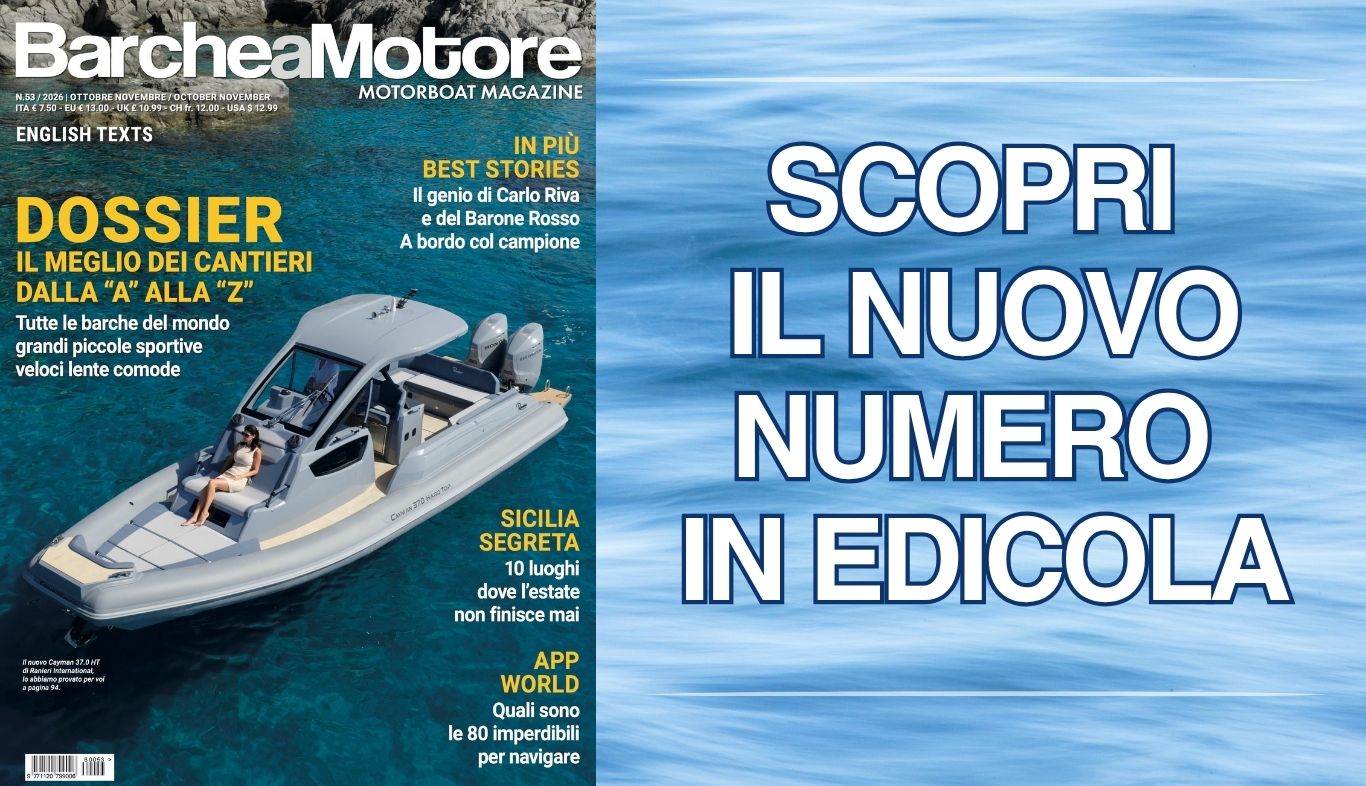
Give or treat yourself to a subscription to Boats in Motion print + digital and for only 39 euros a year you get the magazine at home plus read it on your PC, smartphone and tablet. With a sea of advantages.
90s boats: original tests of 5 outstanding cruisers (13+ m)
Welcome to the Classic Boat column, the historical and cultural “keeper” of the masthead, a place dedicated to an in-depth look at the figures, boats and design developments that have marked the evolution of motor boating. In this article, to help you better navigate a vast panorama such as that of the classic world, we will focus on five specific hulls, five great cruisers of the 1990s that have today become emblematic of the ‘big’ classic boating of the late 20th century…
Great 90s classics: discover the trials of five outstanding ‘cruisers’ (13+ m)
How to narrate five hulls between 1990 and 1999 knowing how to evoke both the perception and impression of the time? By acting directly on the sources and, in our case, by retrieving those very articles with which they were introduced to you then. With 2026, in fact, Boats by Motor started a very large project of digitizing its archives, thus making accessible to you, week after week, all its original evidence from 1990 onward. It is a vast operation that we have called Classic Boat Archive, accessible to all(here) and which, in this specific case, will offer us a unique insight into the recent history of motor boating, thus offering you, and in detail, the historical moment when a specific boat was born… So here are the five great Classic Boats of today (13+ meters), a foretaste of what you can find independently by exploring thededicated Archive…
Sunseeker Predator 63
Sarnico Maxim 40 | 1997; 13 m
Announced at the 1997 Genoa Boat Show, Barche a Motore boarded the Sarnico Maxim 40 in October 1998, officially putting her engine and water lines to the test. Built by Cantieri di Sarnico to high quality standards, this is a 13-meter express-cruiser designed to fit in best with the successful and eponymous Maxim open series, started by the shipyard -with great success- just five years earlier. Cantieri di Sarnico thus offers a medium-sized but high quality hull, complete in equipment and more than well-finished in detail and finish, with generous and well-utilized spaces.
In terms of the hull, however, the Maxim 40 has rather generous measurements, with a particularly pronounced beam (3.88 meters) compared to the 13 meters overall length. A design choice that, while slightly limiting performance, offers great gains in volume. A feature that immediately denotes how much the overall experience and pleasantness of life on board led the design. Although, as a good express cruiser, on board this 40 it is deck accommodation that is the great privilege, considerable volumes nevertheless find a place on board here, with an airy and well laid out L-shaped galley and dinette that can be converted into a double berth. Forward, on the other hand, is the owner’s quarters -large for the range; while it is aft of the saloon that we find the guest cabin. Looking finally at the performance, depending on the motorization, top speeds between 35 and 38 knots. To learn more, go directly to the original article and find out the proof: you can find it HERE or in Boats to Motor 1998, no. 9, October, pp. 134-140..
It was 1995 when the British shipyard Marine Projects (now Princess Yachts) launched its Princess 480, a 15-meter strong with great roominess, ideal for fast, wide-ranging cruising. Developed on the design of the previous 470, with the 480 we are confronted with a hull that knows how to make a treasure out of lessons learned, thus presenting a wealth of improvements. Excellent then is the experience at the helm which, thanks to a special hull design -deep V with double tunnels- is harmoniously progressive and comfortable.
On the live-aboard front, the Princess 480 offers comfortable interior living, with a large salon accessible from the cockpit, large sofas and good volumes of living areas. The galley is located downstairs, as are the two guest cabins and the large owner’s cabin. In terms of performance, however, The Princess 480 was powered by two different engines: 2×430 hp Volvo Penta TAMD 72 and 2×442 hp Caterpillar 3208, for performance that is around 25 knots when cruising, 33 pushing all the way. Low, however, is the minimum planing speed-something positive-which stands at just 11.5 knots. To learn more, go directly to the original article and find out the proof: you can find it HERE or in Motor Boats 1995, no. 6, July, pp. 36-41.
Princess 480
’90s boats. Carnevali 50 Fly | 1998; 15.8 m
It is 1998 when the Carnevali 50 Fly makes its appearance, an elegant, comfortable and safe flying bridge with ample living space on deck. Signed by the renowned Studio Ceccarelli, we are confronted here with a project that is nothing short of meticulous, strong in careful craftsmanship and the use of technologically advanced equipment. Thus is born a flagship simultaneously capable of close to 34 knots of top speed with inboard diesel propulsion in the shaftline, but at the same time strong in that searing acceleration typical of a hull equipped with gasoline thrusters. The medium-deep variable angle V-shaped hull then gives great stability when sailing, even in rough seas.
To meet, however, all the various owner requirements, the Carnevali 50 provides two different interior solutions. On the one hand, a three-cabin, three-bathroom version; on the other, a three-cabin, two-bathroom version. In both cases, the saloon, on the other hand, is furnished with two opposing sofas with an extendable central table and stools, offers a bar cabinet that is also functional as a divider between the galley area, located lower down, and the saloon. Equally brilliant, the exteriors, where it is the flybridge that takes center stage, but without overshadowing too much a well-spaced cockpit and a large teak beach area. To learn more, go directly to the original article and find out the proof: you can find it HERE or in Boats to Motor 1998, no. 1, February, pp. 76-84.
Carnevali 50 Fly
CNA Pershing 57 | 1992; 17.9 m
1992 is the year of the Pershing 57, a brilliant hull signed Cantieri Navali dell’Adriatico. It is in him that Barche a Motore thus discovers an 18-meter strong with great course stability and maneuverability in maneuvering, with a well-kept interior both in terms of aesthetics and quality of materials. An 18-meter long-range cruiser, the Pershing 57 is made in Aramat by CNA and, although it positions itself as a younger sibling of the previous 70-footer, it immediately differs from the latter in a series of highly appropriate construction and aesthetic choices that make it more ‘adult’ than the other from the very first hull launched. Indeed, with this 57 CNA offers us a new concept of an elegant yacht, a refined hull for fast cruising in full comfort. Sleek and aggressive, she gave no small boost to the glories of the Italian-style Open.
The exterior volumes of this boat are graceful and very well proportioned, with sleek lines and pleasing curved solutions. The deck, completely free of obstacles, is also brilliant in terms of habitability. The hull, on the other hand, a deep V at the bow that widens progressively towards the stern to increase lift and two sturdy support skids per side, guarantees excellent stability and comfort, even at 40 knots… Below deck, two aft cabins are dedicated to guests, while at the bow a large double makes the master. Among the three, a remarkable and very complete dinette with open-space galley. To learn more, go directly to the original article and find out the proof: you can find it HERE or in Motor Boats 1992, no. 10, November, pp. 62-67.
The Pershing 57 under sail. Stern exits are clean thanks to an efficient hull with good waterline width. Also of note is the stern gangway, which is fully retractable.
’90s boats. Sunseeker Predator 63 | 1994; 17.56 m
It was 1994 when the Predator 63 was born, not only the firstborn of the range of the same name, but an exceptional performance-cruiser… At the time of its launch, in fact, the Sunseeker Predator 63 was, not only, one of the greatest luxury performance yachts on the scene, but also an innovative hull on several aspects. Its sporty, sleek and curvilinear lines, inspired by the automotive industry, immediately made it an emblem of the new design that was being set, here coupled with an exceptional deep-V hull (30+ kn) and a well-balanced aesthetics thanks to the attention paid to the design of the superstructures. Here, among the first innovative elements is the sunroof, a 1990s novelty, in this case already electrically operable from the wheelhouse.
Looking at life on board, the layout of the 63′ favored, first and foremost, the aft spaces, introduced by a swim platform on the water from which, via short side stairs, there was immediate access to the cockpit on one side and, on the other, to the large sundeck that took up most of its surface area, overlooking the sea. Here, another treat, was already hidden a tender-garage, capable of accommodating a rib or tender up to 4 meters long. A pair of MAN engines of 1100 horsepower each provided enough power to easily reach 30 knots. However, peak top speeds on the 30-plus limit were also recorded. Serving the total 2200 horsepower, over 3000 liters of fuel tank provided enough range for weekend getaways and small cruises. To learn more, go directly to the original article and discover the proof: you can find it HERE
Sunseeker Predator 63
Are you a classic boating enthusiast? Check out our Classic Boat column and Classic Boat Archive, the best places to delve into the history and details of motor boating. Click HERE Want to celebrate your Classic Boat and share a piece of boating history with us? Write to our Classic Boat editorial staff (cl*********@***********re.com) or find out how to do so through this article here
Powerboats, its stories, from small open to motoryachts. Sign up now for our free newsletter and receive the best news selected by the editorial staff each week. Enter your email below, agree to the Privacy Policy and click the “sign me up” button.
The second edition of Seaquip, the leading B2B event dedicated to marine accessories, technologies, and components—scheduled for March 2–4, 2027, at the Fiera Milano Rho exhibition center—continues to attract a lineup of top-tier participants. New confirmations of participation from leading players in the maritime industry further reinforce the event’s international scope, highlighting Milan’s logistical and
Welcome to the Classic Boat column, the magazine’s historical and cultural “guardian”—a space dedicated to exploring the figures, boats, and design developments that have shaped the evolution of motorboating. In this article, we’ll retrace our steps to look back at three pivotal moments— three beginnings destined to become the starting point of a broader adventure:
Portofino 10 Fly The Portofino 10 Fly, featured in the May 1994 issue, is the result of a winning combination of modern construction technologies and the tradition of Ligurian shipbuilding. The result is a hull perfectly suited for long-range cruising, capable of handling challenging sea conditions. It was designed by Angelo Zagano. Excerpted from *Barche
All it takes is a warmer or colder day, and the inflatable boat changes shape. These aren’t leaks, of course, but rather the tubes, which have varying internal pressure depending on the temperature. The lower the temperature, the lower the pressure. If we leave the inflatable boat in the sun all day, however, the air
Gestisci Consenso Cookie
Per fornire le migliori esperienze, utilizziamo tecnologie come i cookie per memorizzare e/o accedere alle informazioni del dispositivo. Il consenso a queste tecnologie ci permetterà di elaborare dati come il comportamento di navigazione o ID unici su questo sito. Non acconsentire o ritirare il consenso può influire negativamente su alcune caratteristiche e funzioni.
Funzionale
Always active
L'archiviazione tecnica o l'accesso sono strettamente necessari al fine legittimo di consentire l'uso di un servizio specifico esplicitamente richiesto dall'abbonato o dall'utente, o al solo scopo di effettuare la trasmissione di una comunicazione su una rete di comunicazione elettronica.
Preferenze
L'archiviazione tecnica o l'accesso sono necessari per lo scopo legittimo di memorizzare le preferenze che non sono richieste dall'abbonato o dall'utente.
Statistiche
L'archiviazione tecnica o l'accesso che viene utilizzato esclusivamente per scopi statistici.L'archiviazione tecnica o l'accesso che viene utilizzato esclusivamente per scopi statistici anonimi. Senza un mandato di comparizione, una conformità volontaria da parte del vostro Fornitore di Servizi Internet, o ulteriori registrazioni da parte di terzi, le informazioni memorizzate o recuperate per questo scopo da sole non possono di solito essere utilizzate per l'identificazione.
Marketing
L'archiviazione tecnica o l'accesso sono necessari per creare profili di utenti per inviare pubblicità, o per tracciare l'utente su un sito web o su diversi siti web per scopi di marketing simili.