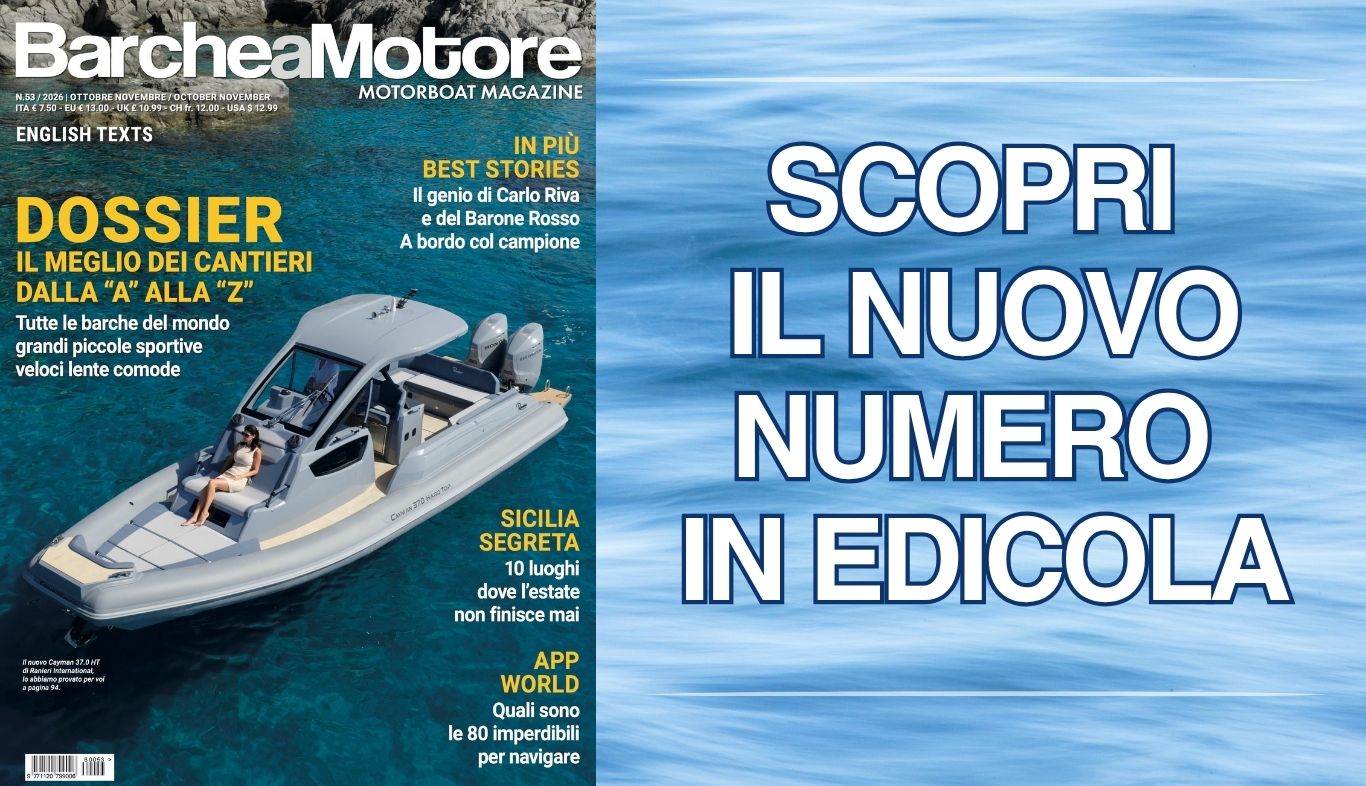
Give or treat yourself to a subscription to Boats in Motion print + digital and for only 39 euros a year you get the magazine at home plus read it on your PC, smartphone and tablet. With a sea of advantages.
The new flagship of the F-Line range, the F6.7 designed by Garroni Studio, is a planing flybridge yacht with ample, unobstructed spaces
The French shipyard Prestige is preparing to write a new, important chapter in its 35-year history. At the Les Herbiers facility in the Vendée, the F6.7—the flagship of the F-Line range—is taking shape and will make its official debut atthe upcoming Cannes Yachting Festival, scheduled for September 8–13. Following the success of the F4.3, F4.9, and F5.7 models, this new yacht represents the most accomplished and mature expression of the brand’s philosophy.
And to achieve this, Prestige has once again chosen to rely on the design skills and vision of Italian designer Camillo Garroni. Smooth flow along the deckways, a remarkably spacious flybridge (measuring 26 square meters—a rarity for boats of this size), and the generous size of the windows are the key design features of this vessel.
Prestige F6.7
The F6.7 embodies the qualities of a planing flybridge with IPSpropulsion. This is one reason why its beam hasn’t been pushed to the extreme, as is the case with most other models in the same class. But then, how can we convey to the owner that sense of spaciousness that everyone wants?
The solution comes directly from Studio Garroni: the removal of barriers to create a seamless transition between the cockpit, salon, and galley, and the use of large windows that flood the space with light and establish a visual connection between the interior and exterior, creating a sense of spaciousness.
Inspired by the world of catamarans—though, of course, reimagined—the concept features an island kitchen situated between the cockpit and the helm station at the bow. While this promotes a convivial atmosphere between guests and the owner, it can also compromise privacy when the crew is cooking.
Fortunately, a truly impressive beach club has been designed at the stern: the spacious sun deck is complemented by a platform that sits flush with the water, creating a seamless transition between the flagship and the surrounding marine environment. This is a feeling that owners are now clamoring for, precisely because yachts in this category are primarily enjoyed while at anchor.
The distinctive two-level stern of the F6.7: a sheltered living area, a sun deck, and a platform over the water
The flybridge: the F6.7’s standout feature
A boat just over twenty meters long and a 26-square-meter flybridge. How often have you seen these dimensions combined? Rarely, very rarely. This is another standout feature of the Prestige F6.7: its generous space allows for a variety of layouts: from a more living-room-style layout with two L-shaped sofas and a central coffee table to one featuring a sun deck and chaise longue, all the way to the option of a more personalized configuration with removable furnishings.
The flybridge thus becomes a true panoramic terrace suspended between the sky and the sea, designed for relaxation and for enjoying the cruise from a privileged vantage point.
A key feature is the 26-square-meter flybridge: there are several layout options for customization
Prestige F6.7. Four “quiet luxury” cabins
The hallmark of the interior on the flagship of the F-Line family is the unique philosophy of “whispered luxury”: below deck, the quality of the materials and the refinement of the details are evident with the utmost discretion. No ostentation, just luxurious understated elegance. The owner’s cabin, despite its forward location, is larger than the VIP cabin at the stern. The VIP cabin, taking full advantage of the beam, offers ample space. Between these two, more centrally located, are two additional guest cabins, and—as an option—the crew cabin next to the engine room, directly behind the VIP cabin.
Despite its forward location, the galley offers excellent livability and ample floor space
The Powertrain: Full Confidence in Volvo IPS Technology
The partnership between Prestige and Volvo IPS continues on the newly launched F 6.7. Two engine configurations are available: a pair of 900 cv Volvo Penta D13 IPS1200 engines or two 1,000 cv Volvo Penta D13 IPS1350 engines. According to the shipyard, the flagship is expected to maintain a cruising speed of 22 knots and reach top speeds of between 29 and 30 knots.
Behind the lines of the F6.7 lies an impressive design and manufacturing effort. The shipyard brought together more than 15 different disciplines—from naval architecture to cabinetmaking, from high-end upholstery to state-of-the-art propulsion systems—coordinated by a team of 25 specialists entirely dedicated to the project.
Although the industrial processes used are at the cutting edge of marine technology, much of the interior and exterior finishing is still done entirely by hand. It is this blend of industrial precision and artisanal “savoir-faire” that promises to establish the F6.7 as a true benchmark for the most experienced and detail-oriented boat owners.
The layout of the salon, featuring an island kitchen between the cockpit and the helm station, enhances the sense of togetherness on board
Powerboats, its stories, from small open to motoryachts. Sign up now for our free newsletter and receive the best news selected by the editorial staff each week. Enter your email below, agree to the Privacy Policy and click the “sign me up” button.
The second edition of Seaquip, the leading B2B event dedicated to marine accessories, technologies, and components—scheduled for March 2–4, 2027, at the Fiera Milano Rho exhibition center—continues to attract a lineup of top-tier participants. New confirmations of participation from leading players in the maritime industry further reinforce the event’s international scope, highlighting Milan’s logistical and
Welcome to the Classic Boat column, the magazine’s historical and cultural “guardian”—a space dedicated to exploring the figures, boats, and design developments that have shaped the evolution of motorboating. In this article, we’ll retrace our steps to look back at three pivotal moments— three beginnings destined to become the starting point of a broader adventure:
Portofino 10 Fly The Portofino 10 Fly, featured in the May 1994 issue, is the result of a winning combination of modern construction technologies and the tradition of Ligurian shipbuilding. The result is a hull perfectly suited for long-range cruising, capable of handling challenging sea conditions. It was designed by Angelo Zagano. Excerpted from *Barche
All it takes is a warmer or colder day, and the inflatable boat changes shape. These aren’t leaks, of course, but rather the tubes, which have varying internal pressure depending on the temperature. The lower the temperature, the lower the pressure. If we leave the inflatable boat in the sun all day, however, the air
Gestisci Consenso Cookie
Per fornire le migliori esperienze, utilizziamo tecnologie come i cookie per memorizzare e/o accedere alle informazioni del dispositivo. Il consenso a queste tecnologie ci permetterà di elaborare dati come il comportamento di navigazione o ID unici su questo sito. Non acconsentire o ritirare il consenso può influire negativamente su alcune caratteristiche e funzioni.
Funzionale
Always active
L'archiviazione tecnica o l'accesso sono strettamente necessari al fine legittimo di consentire l'uso di un servizio specifico esplicitamente richiesto dall'abbonato o dall'utente, o al solo scopo di effettuare la trasmissione di una comunicazione su una rete di comunicazione elettronica.
Preferenze
L'archiviazione tecnica o l'accesso sono necessari per lo scopo legittimo di memorizzare le preferenze che non sono richieste dall'abbonato o dall'utente.
Statistiche
L'archiviazione tecnica o l'accesso che viene utilizzato esclusivamente per scopi statistici.L'archiviazione tecnica o l'accesso che viene utilizzato esclusivamente per scopi statistici anonimi. Senza un mandato di comparizione, una conformità volontaria da parte del vostro Fornitore di Servizi Internet, o ulteriori registrazioni da parte di terzi, le informazioni memorizzate o recuperate per questo scopo da sole non possono di solito essere utilizzate per l'identificazione.
Marketing
L'archiviazione tecnica o l'accesso sono necessari per creare profili di utenti per inviare pubblicità, o per tracciare l'utente su un sito web o su diversi siti web per scopi di marketing simili.